Medicine & Public Health
-
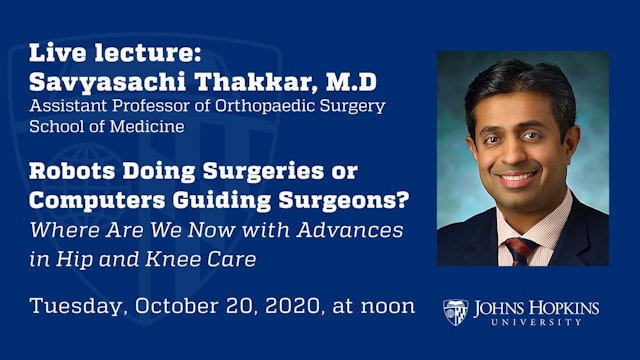
Robots Doing Surgeries or Computers Guiding Surgeons Advances
There are several advances in the non-operative and operative care of patients with hip and knee problems. Technical and technological innovations have provided a cutting-edge to patients and providers alike. Savyasachi “Savya” Thakkar, M.D., Assistant Professor of Orthopaedic Surgery, leads a di...
-
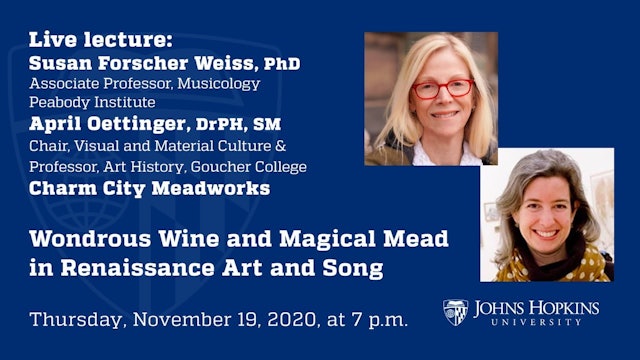
Wondrous Wine and Magical Mead in Renaissance Art and Song
In vino veritas! As the ancient Roman encyclopedist Pliny the Elder (1st c., c.e.) famously put it, the fermented grape possesses the power to elucidate truth and to foment joy and laughter. Join Dr. Susan Weiss (Associate Professor of Musicology, JHU) and Dr. April Oettinger (Professor of Art Hi...
-
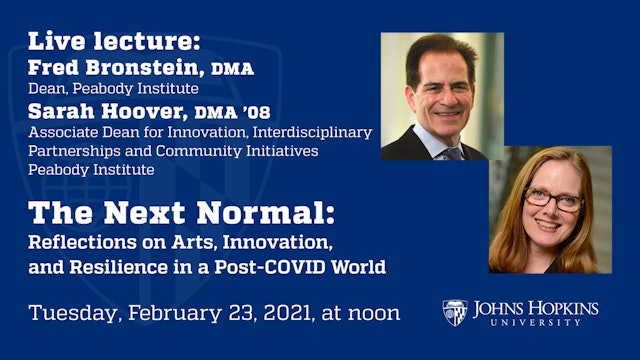
The Next Normal: Reflections on Arts Innovation and Resilience Post-COVID
The performing arts industry has been thoroughly upended by the COVID-19 pandemic, with venues shut down, performances canceled, and artists out of work. A Brookings Institution report issued last summer estimated the damage in the fine and performing arts at almost 1.4 million jobs and $42.5 bil...
-
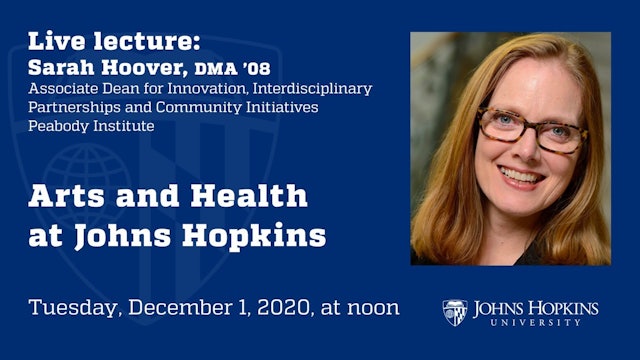
Arts and Health at Johns Hopkins
What might healing look like if the arts were thoroughly integrated into the healthcare environment? What would Johns Hopkins University and Health Systems look like if precision medicine and state-of-the-art care included (1) the arts in training, professional development, and support for the we...
-
How Bibliotherapy Can Help Us Process Challenging Emotions and Connect
3 items
Baltimore City’s residents have long struggled with issues of inequity, poverty, and violence. In 2020, on top of a crippling pandemic, Baltimore saw 335 individuals die by homicide. In the face of a virtual school year necessitated by quarantine, opportunities for young people to connect with ea...
-
How Bibliotherapy Can Help Us Process Challenging Emotions - Session 3
Baltimore City’s residents have long struggled with issues of inequity, poverty, and violence. In 2020, on top of a crippling pandemic, Baltimore saw 335 individuals die by homicide. In the face of a virtual school year necessitated by quarantine, opportunities for young people to connect with ea...
-
How Bibliotherapy Can Help Us Process Challenging Emotions - Session 1
Baltimore City’s residents have long struggled with issues of inequity, poverty, and violence. In 2020, on top of a crippling pandemic, Baltimore saw 335 individuals die by homicide. In the face of a virtual school year necessitated by quarantine, opportunities for young people to connect with ea...
-
How Bibliotherapy Can Help Us Process Challenging Emotions - Session 2
Baltimore City’s residents have long struggled with issues of inequity, poverty, and violence. In 2020, on top of a crippling pandemic, Baltimore saw 335 individuals die by homicide. In the face of a virtual school year necessitated by quarantine, opportunities for young people to connect with ea...
-
On the Road with JHU - Terroir: A Sense of Place for Food and Drinks
Derived from the French word terre, meaning “earth”, terroir refers to the environmental factors that affect crops in specific reasons. During this event, you’ll uncover the terroir of the Pacific Northwest region of the United States through three lenses while exploring some wine from the region...
-
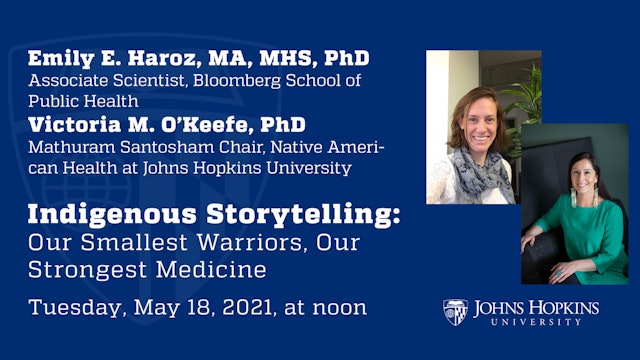
Indigenous Storytelling
The traditions, strengths, and resilience of communities have carried Indigenous peoples for generations. Drs. O’Keefe and Haroz will discuss the development and dissemination of “Our Smallest Warriors, Our Strongest Medicine: Overcoming COVID-19,” a children’s book aimed at providing indigenous ...
-
Session 1: Manipulating Life: The Ethics of Emerging Biotechnologies
Jeffrey Kahn, PhD, MPH - the Andreas C. Dracopoulos Director of the Johns Hopkins Berman Institute of Bioethics and the Levi Professor of Bioethics and Public Policy - provides an introduction to the ethics of gene editing. In this first session, Dr. Kahn uses the first case in the world of the c...
-
Session 2: Manipulating Life: The Ethics of Emerging Biotechnologies
Jeffrey Kahn, PhD, MPH - the Andreas C. Dracopoulos Director of the Johns Hopkins Berman Institute of Bioethics and the Levi Professor of Bioethics and Public Policy - provides an introduction to the ethics of gene editing. This session examines some of the implications of a range of potential us...
-
Session 2: Living With Pain: The Puzzle of Addiction
In Session 2, Hanna Pickard - a Bloomberg Distinguished Professor of Philosophy and Bioethics cross-appointed to the William H. Miller III Department of Philosophy and the Berman Institute of Bioethics - defines the puzzle of addiction along with the choice in addiction moving beyond the debate b...
-
Session 1: Living With Pain: America’s Opioid Dilemma
In Session 1, Travis N. Rieder - a philosopher and bioethicist at the Johns Hopkins Berman Institute of Bioethics, where he directs the Master of Bioethics degree program - covers the simultaneous under treatment and overtreatment of pain; the history of pain medicine and opioid misuse in America...
-
Session 3: Living With Pain: A Conversation About Drugs and Addiction
In Session 3, recorded as a live webcast, Hanna Pickard - a Bloomberg Distinguished Professor of Philosophy and Bioethics cross-appointed to the William H. Miller III Department of Philosophy and the Berman Institute of Bioethics - and Travis N. Rieder - a philosopher and bioethicist at the Johns...
-
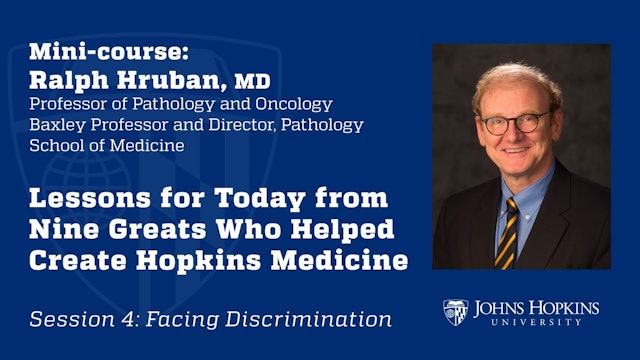
Session 4: Nine Greats Who Helped Create Hopkins Medicine
The founding of the Johns Hopkins University School of Medicine fundamentally changed medicine in America. In the blink of an eye, medicine was transformed from a trade practiced by poorly educated craftsmen, to a science practiced by highly educated physicians. While this transformation may seem...
-
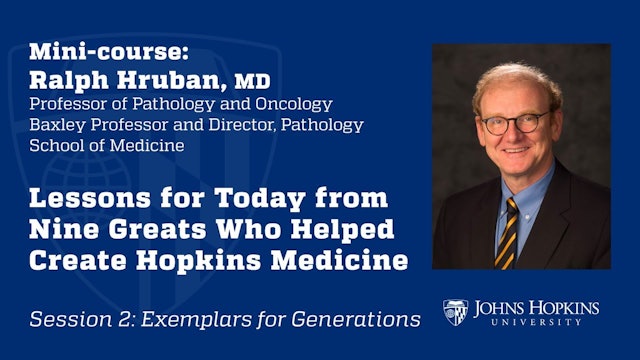
Session 2: Nine Greats Who Helped Create Hopkins Medicine
The founding of the Johns Hopkins University School of Medicine fundamentally changed medicine in America. In the blink of an eye, medicine was transformed from a trade practiced by poorly educated craftsmen, to a science practiced by highly educated physicians. While this transformation may seem...
-
Session 3: Nine Greats Who Helped Create Hopkins Medicine
The founding of the Johns Hopkins University School of Medicine fundamentally changed medicine in America. In the blink of an eye, medicine was transformed from a trade practiced by poorly educated craftsmen, to a science practiced by highly educated physicians. While this transformation may seem...
-
Session 1: Nine Greats Who Helped Create Hopkins Medicine
The founding of the Johns Hopkins University School of Medicine fundamentally changed medicine in America. In the blink of an eye, medicine was transformed from a trade practiced by poorly educated craftsmen, to a science practiced by highly educated physicians. While this transformation may seem...
-
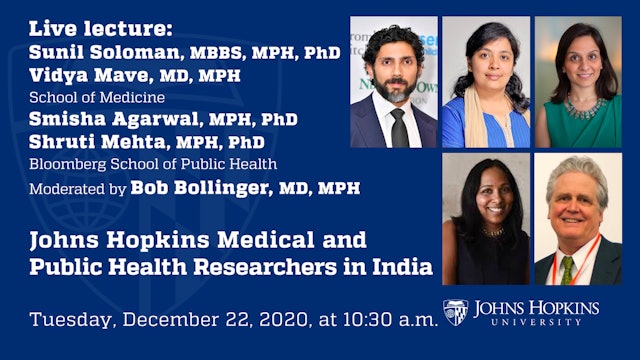
A Conversation with Johns Hopkins Medical and Public Health Researchers in India
Join the Johns Hopkins India Institute for a look at Hopkins research projects in India involving access to care for at-risk populations, tuberculosis studies, maternal-child health, and leveraging innovative technological solutions.
Sunil Solomon, MBBS, MPH '04, PhD '09 is an Assistant Professo...
-
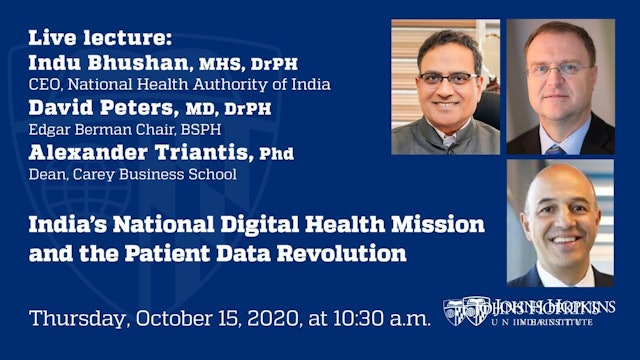
India’s National Digital Health Mission and the Patient Data Revolution
Co-Hosted by the Johns Hopkins India Institute
For decades, global health systems have been transitioning from paper to electronic health records to improve patient data accessibility, particularly to facilitate epidemiological study and preventive care. At the same time, they have wrestled with...
-
Meatless Monday
Meatless Monday with its simple message, “One day a week, cut the meat,” started in 2003 in collaboration with the Johns Hopkins Center for a Livable Future (CLF). Since then it has grown in recognition and practice to over 40 countries globally, anchoring action for health, climate and other env...
-
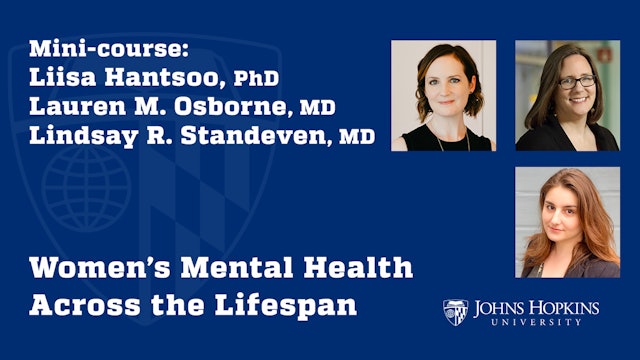
Women’s Mental Health Across the Lifespan
4 items
Throughout their lifetime, women will experience changes in their moods as a consequence of aging. From puberty to post-menopause, these physical, emotional, and physical changes can be confusing and concerning. Join faculty – Liisa Hantsoo, Lauren M. Osborne, and Lindsay R. Standeven – from the ...
-
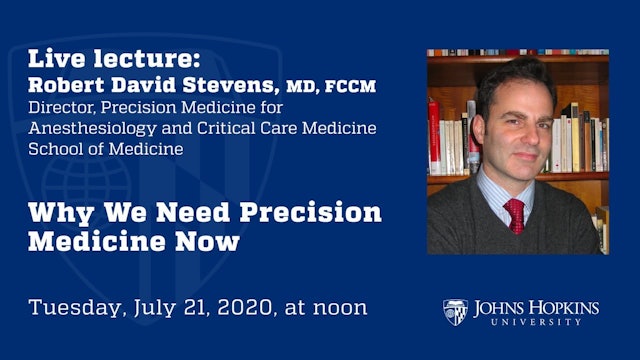
Why We Need Precision Medicine Now
The current pandemic has challenged many assumptions on the health of populations. Join Robert Davis Stevens, Director of Precision Medicine for Anesthesiology and Critical Care Medicine, to discuss Precision Medicine as a disruptive framework which focuses on the specific characteristics and nee...