What If Fungi Win?
Staff Picks
•
1h 3m

From the delicious to the deadly, fungi—which share 50% of our DNA—present a wide range of benefits, and threats, to human health, many of which remain unexplored. Could fungal pathogens outsmart us before we find ways to combat them?
Arturo Casadevall, Bloomberg Distinguished Professor and Chair of Molecular Microbiology & Immunology at Johns Hopkins University, takes up this question and discusses his latest book, What If Fungi Win?, in conversation with Emily Kwong, founder and co-host of NPR's science podcast Short Wave.
What If Fungi Win? is part of the Johns Hopkins Wavelengths series published by the Johns Hopkins University Press. For more information, visit https://www.press.jhu.edu/books/title/53673/what-if-fungi-win. This event is presented by the Sheridan Libraries & University Museums, Johns Hopkins Wavelengths, and Hopkins at Home.
Chapter Markers:
00:00:25 - Elisabeth Long, Sheridan Dean of Libraries, Archives, and Museums at Johns Hopkins, Introduces the Program and Guests.
00:05:47 - Emily Kwong and Arturo Casadevall Conversation
00:41:26 - Emily opens it up to Audience questions for Arturo
#jhu #johnshopkins #hopkinsathome #hopkins #johnshopkinswavelengths #johnshopkinsuniversitypress #sheridanlibraries #whatiffungiwin
Up Next in Staff Picks
-
Dean's Notebook | Books, Authenticity...
Brought to you by Hopkins at Home and the Krieger School of Arts & Sciences
Books, Authenticity, and the Truth:
The history of misinformation, from the Renaissance to todayWe are living through a crisis in how we take in information. Bombarded by information of all sorts coming at us on phones...
-
Lunch with the Libraries & Museums: B...
Presented by Hopkins at Home, Sheridan Libraries, and Friends of the Johns Hopkins University Libraries
Joseph Plaster is joined by archivist Tonika Berkley and 2023 Tabb Center Fellow Nicoletta Darita de la Brown to discuss the exhibition "Be(longing): Unveiling the Imprint of Black Women Hidde...
-
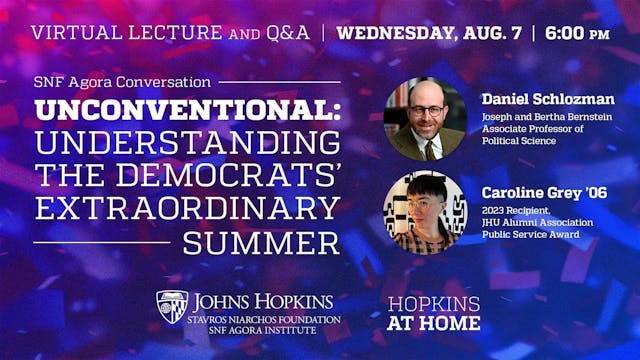
UnConventional: Understanding the Dem...
Presented by Hopkins at Home and The SNF Agora Institute at Johns Hopkins University
The dizzying recent course of events in American politics has left many people asking: how did things get to this point, and what happens next? JHU professor of political science Daniel Schlozman, an expert on ...